If your next job is to find website problems and keep track of important keywords, Seobility is a sensible starting point. Its Website Audit combines prioritized findings with fix guidance, while Ranking Monitoring lets you follow chosen keywords and compare competitors.
If you need to investigate how a competitor’s search visibility changed before you started tracking it, put Sistrix on your shortlist. Its Visibility Index is built for that historical view. Just check the plan’s history allowance before subscribing: the entry tier may not reach the period you want to investigate. Sistrix’s pricing table lists that allowance by tier.
This isn’t an “audits versus research” split. Sistrix also offers audits and keyword tracking, and Seobility includes competitor comparisons. The useful question is which workflow you need often enough to pay for.
A quick way to narrow the choice
| Your next job | Where to start | What to check |
|---|---|---|
| Turn problems on your own site into a repair list | Seobility, for its prioritized audit findings and explanations | Can you understand the findings and turn them into work you can assign? |
| Investigate a competitor’s visibility over an earlier period | Sistrix, for historical domain visibility analysis | Does the selected tier cover the country, dataset and dates you need? |
| Monitor a specific set of commercially important keywords | Evaluate both: both offer keyword tracking | Test your actual keywords, locations and required update schedule. |
| Assess a small local or specialist business | Begin with relevant keywords, not a broad visibility score | Sistrix says some niches and regional terms need a custom project index.1 |
These are starting points for an evaluation, not results from a head-to-head software test.
Start with the question you need to answer
Imagine a competitor has become much more noticeable in your market. You want to know whether its growth began recently or reflects a longer change.
Sistrix’s historical visibility data gives you a way to investigate that question. You can look at a domain’s development and examine more specific parts of the site, such as directories or individual URLs.
The next step is interpretation. In this hypothetical investigation, compare the timing of the change with the competitor’s pages and your own observations. A chart can give you a lead to investigate; it doesn’t, by itself, prove what caused the movement.
Also, visibility isn’t traffic. Sistrix explicitly distinguishes its Visibility Index from a count of website visitors. The vendor also notes that small niches and regional or long-tail terms may not be sufficiently represented in the standard keyword set.1
That matters if you’re choosing software for a local service business. A broad domain score shouldn’t replace checking the searches that bring relevant customers to that business.
For a different question—“How are our selected keywords doing?”—Seobility’s Ranking Monitoring offers a more direct place to start. You enter the keywords you want to follow and compare positions with competitors. Sistrix also has keyword tracking, so this is a workflow choice rather than a feature Seobility alone provides.
Before paying for either tool, write down one question you expect its data to answer. If you can’t name a decision you’d make differently, more data may not be your immediate need.
Audits and tracking: compare the actual job
Seobility’s audit covers problems such as broken links, duplicate content, crawl errors and metadata issues. Findings come with explanations and priorities. That makes it worth evaluating when the main challenge is turning an audit into a manageable repair list.
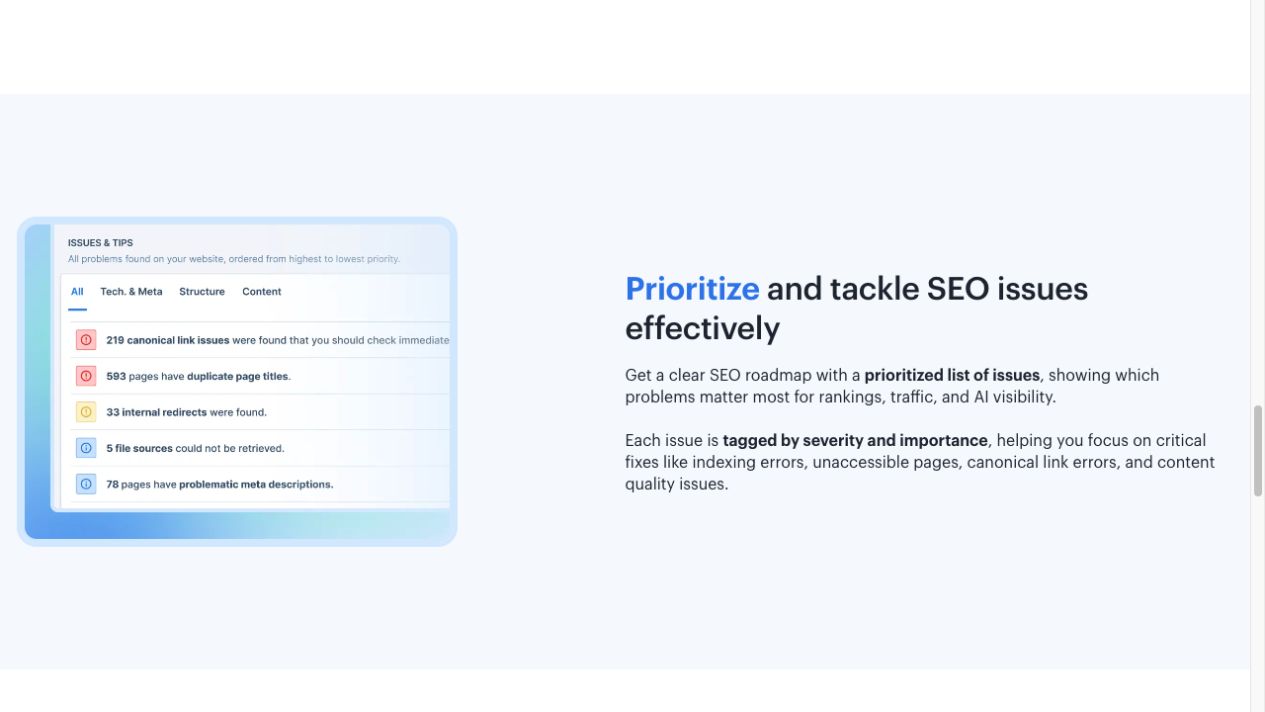
Sistrix also documents automated on-page audits with improvement tips. There isn’t enough evidence here to declare one crawler more thorough or accurate.
A useful test is much smaller than a feature checklist:
- Choose one site you know well.
- Inspect a few findings you can verify yourself.
- Ask whether the explanation tells you what to investigate or change.
- Give one finding to the person who would implement the fix.
For rank tracking, check what “daily” means in the plan you are considering. Seobility’s pricing documentation distinguishes desktop, mobile and deeper-ranking update schedules. Don’t assume every tracked result refreshes daily.
There is a similar distinction in AI-related features: Seobility documents Google AI Overview tracking, but labels its separate ChatGPT/Gemini visibility tracking as coming soon. If that broader tracking is essential to your purchase, don’t count a forthcoming feature as available today. The ranking page explains the distinction.
What will the right plan cost?
For a few website projects, the entry price may be enough to narrow your shortlist. If you’re buying Sistrix to investigate an older event, the history allowance deserves just as much attention as the monthly fee.
The figures below were checked on the official Seobility pricing page and Sistrix pricing page on August 30, 2026. Both displayed euros in the views inspected. These are monthly-billing prices, not annual-discount equivalents or converted US-dollar quotes. Paid Seobility prices are plus applicable VAT; Sistrix states prices are plus taxes.
| Product | Plan | Listed monthly price |
|---|---|---|
| Seobility | Basic | Free |
| Seobility | Premium | €49.90 |
| Seobility | Agency | €179.90 |
| Sistrix | Start | €119 |
| Sistrix | Plus | €239 |
| Sistrix | Professional | €419 |
| Sistrix | Premium | €799 |
Seobility has the lower listed paid entry price in this comparison. That doesn’t make the subscriptions interchangeable: choose the allowance and capabilities you need before comparing the bill. US buyers should confirm the offered currency, taxes and terms at checkout.
Check how far back the history goes
Sistrix’s current pricing table lists these data-history allowances:
| Sistrix plan | Data History row |
|---|---|
| Start | 3 months |
| Plus | 5 years |
| Professional / Premium | Full (11 Years) |
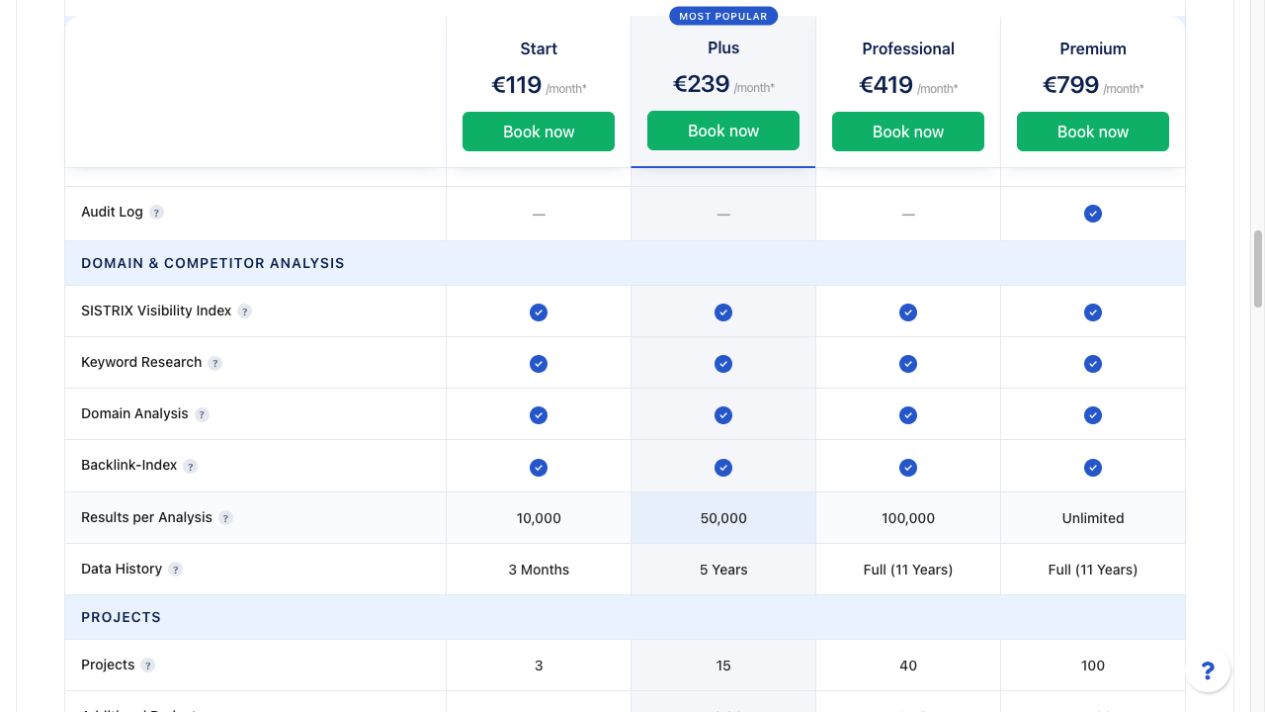
If your research question concerns a change two years ago, Start’s listed three-month allowance is not the match to assume. Ask Sistrix to confirm access to the specific historical dataset, country and period before choosing a tier. The table is more useful for that purchase decision than a general promise of “historical data.”
Compare crawl allowances in the same units
Seobility Premium includes three projects, up to 25,000 pages analyzed per crawl, per project, and 300 ranking keywords. Sistrix Start lists three projects and 30,000 total URLs crawled across projects per month.
Those page counts describe different allowances. Suppose, purely as an example, you want to crawl 10,000 URLs three times in a month. That’s 30,000 URL checks before allowing for extra URLs or other projects. It illustrates why a monthly total can matter even when an individual site fits comfortably within a per-crawl limit; it is not a measured consumption test.
For a smaller starting point, Seobility Basic includes one project, up to 1,000 pages per crawl and 10 ranking keywords. Check those limits against your site rather than treating “free” as sufficient on its own.
A short test before you choose
Keep the evaluation focused on work you already need to do:
- One website: can you explain and act on the audit findings?
- A small keyword sample: does it cover your important searches and locations?
- One competitor question: does the available history answer it?
- One handoff: can a colleague use the output without your narration?
- One suitable plan: are the needed dates, volumes and recurring costs included?
Record what remains unanswered. A trial is useful when it resolves those questions, not simply when it produces more reports.
Bottom line
Start with Seobility if your immediate priority is a practical audit-and-tracking workflow and its allowances fit your site. Give Sistrix a closer look if historical competitor visibility is central to the decisions you make—and budget for the tier that covers the period you need.
You don’t need to settle which tool is “best” in every category. You need to find out which one helps you complete your next recurring SEO task at a cost you can justify.
Sources and methodology
This is a comparison of public vendor documentation and pricing checked on August 30, 2026, not a hands-on benchmark. Recommendations and hypothetical examples are editorial interpretations of the linked evidence.
Review platforms and public discussions were consulted, but the accessible material was insufficient for a verified, individual-review-based verdict. No customer consensus or measured usability winner is claimed.
Research reused a dated US comparison SERP. Additional pricing and visibility searches were manual, location-limited first-page checks, not complete normalized top-ten datasets. The article therefore makes no claim that its approach is unique across all ranking pages.
Screenshots show excerpts of the official pages on the capture date. They illustrate the documented features and terms, not our own product testing or vendor endorsement. Prices and plan details should be checked again before publication or purchase.
Footnotes
-
Sistrix, Visibility Index: Strengths & Limits, retrieved August 30, 2026. Explains the difference from traffic and limitations for niche, long-tail and regional keyword sets. ↩ ↩2