Seobility is worth shortlisting when your main job is keeping a website healthy, monitoring rankings and finding relevant keywords. Semrush deserves a closer look when competitor research is a regular part of your content planning. Both cover the basics; the decision is how much of the additional workflow you will actually use.
That does not make this a choice between a beginner tool and a professional tool. A small team can have demanding research needs. An experienced SEO can want a focused way to check a handful of sites. Start with the work, then compare the subscription that supports it.
What both tools can do
Seobility Website Audit identifies technical and on-page issues and helps you prioritize them. Ranking Monitoring and the Keyword Research Tool cover the next questions: where are your pages appearing, and which searches could you target? Seobility also documents competitor ranking, keyword and backlink analysis.
Semrush’s SEO plan includes Site Audit, Position Tracking and keyword and competitor research. Its Keyword Gap tool lets you investigate overlap and missing opportunities across domains.
An audit is useful only if you can turn a finding into a fix. During your evaluation, open one issue you recognize on your own site. Can you identify the affected page, understand the recommendation and explain the next action to whoever maintains the website? That is a more useful test than counting how many checks appear in a feature list.
Start with the work, not the plan name
Imagine you manage one site with 2,000 pages. You want to track 200 keywords, run four full crawls each month and review competitors when planning next month’s content. This is an illustrative workload, not a test performed for this article.
Here is how the relevant allowances line up:
| Requirement | Seobility Premium | Semrush SEO |
|---|---|---|
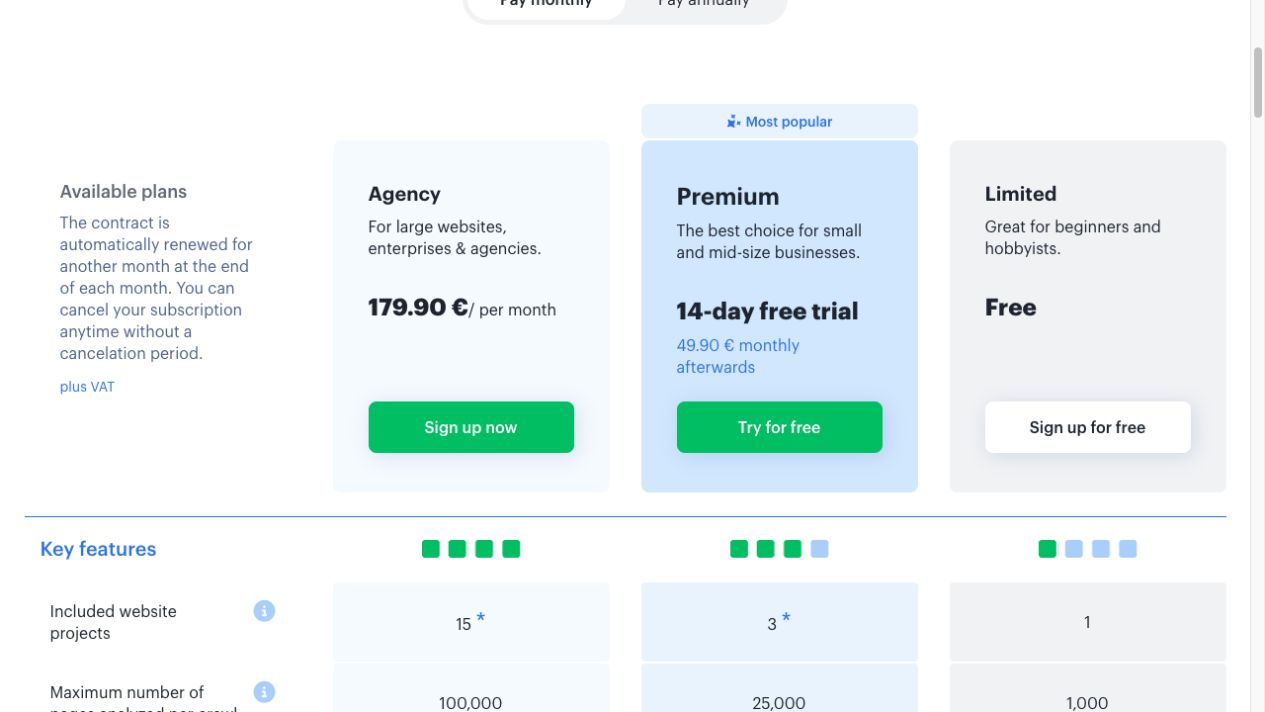
| One monitored website | Three projects included | Five websites included |
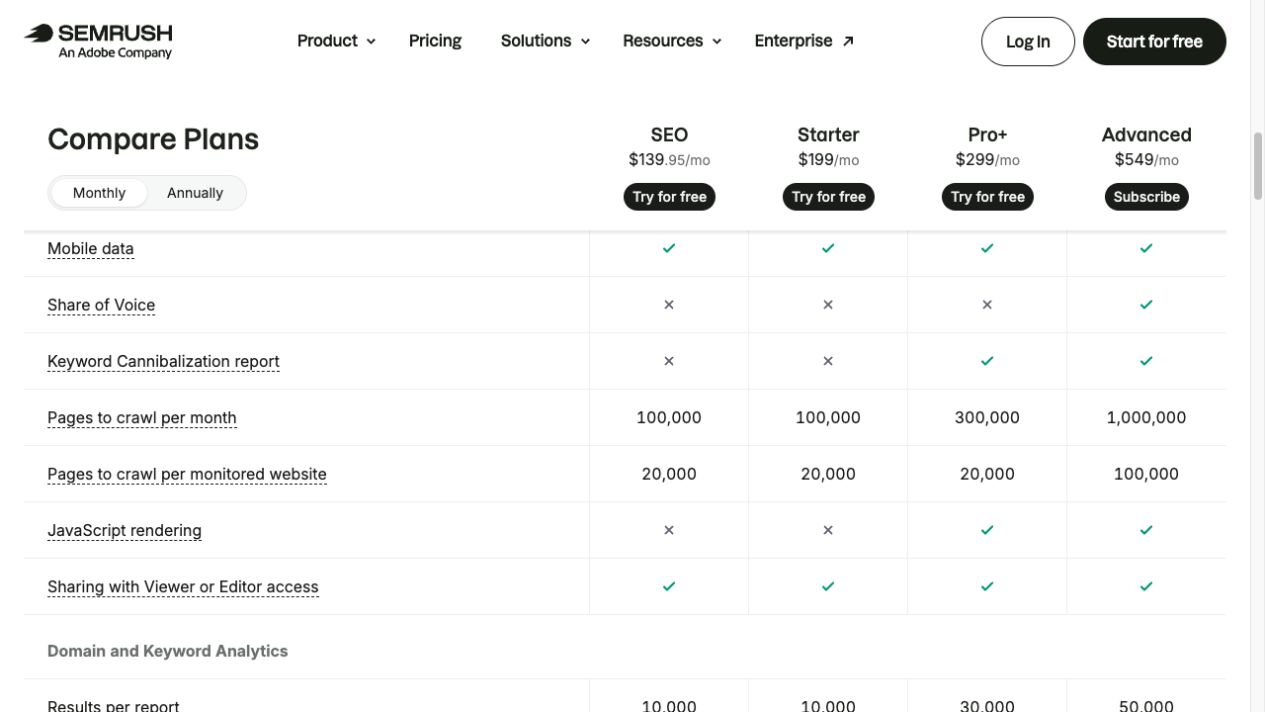
| A 2,000-page crawl | Up to 25,000 pages per project per crawl | Up to 20,000 pages per monitored website; 100,000 crawl pages per month |
| 200 tracked keywords | 300 included | 500 included |
| Official allowance source | Seobility plan comparison | Semrush plan comparison |
Both plans accommodate the example’s stated site and keyword counts. Four crawls of 2,000 pages amount to 8,000 crawl pages before any extra crawling, within Semrush’s listed monthly allowance. That arithmetic does not establish how completely either crawler will discover your site or how long a crawl will take. Check those things on your actual website.
The units matter. Seobility’s 25,000-page figure applies to a project and crawl. Semrush lists both a per-website limit and a monthly pool. Comparing 25,000 with 100,000 as if they measured the same thing would give you the wrong picture. Check the Seobility limits alongside the Semrush limits when estimating a larger workload.
Research usage deserves its own check. Premium includes 50 daily requests shared across Seobility’s standalone tools, not 50 requests for every tool separately. If you expect to spend whole afternoons researching domains and keywords, map that activity to the shared request allowance.
When keyword research changes the choice
A keyword gap is a search your competitor ranks for that your own site does not. It gives you a starting point for investigation—not an instruction to create a page for every term.
Seobility’s Keyword Research Tool supports keyword ideas, domain or URL research, and gap or intersection analysis against up to two competitors. An intersection shows terms shared across the compared domains. This is a practical route to checking whether a competitor covers a topic you have overlooked.
Semrush Keyword Gap also compares keyword profiles. Its documented workflow includes organic, paid and product-listing-ad keywords, together with filters for narrowing the results. Those distinctions become useful when you want to investigate several kinds of search competition rather than build a short organic content list. Check access to the particular advanced functions you need before choosing a current plan.
Try one real content decision in each tool: choose a service or product category, compare relevant competitors and identify three topics worth investigating. Write down why each topic matters to your customers. If one workflow gets you to a defensible shortlist with less manual sorting, you have a reason to prefer it. If both give you what you need, broader capabilities alone are not a reason to buy more software.
What the subscriptions cost
The useful price is the one attached to the work you need done. A larger subscription can make sense if it replaces a research task you already do; unused capacity is harder to justify.
The figures below were checked on the official websites on August 30, 2026. They use monthly billing, not annual-billed monthly equivalents. Seobility displayed euros in the inspected pricing page; Semrush displayed US dollars. These are deliberately labeled, not converted into a claimed savings percentage.
| Option | Displayed price | What to consider |
|---|---|---|
| Seobility free plan | Free | One project, 1,000 pages per crawl and 10 tracked keywords; below the example workload |
| Seobility Premium | €49.90/month, plus VAT where applicable | The paid plan used in the workload comparison |
| Semrush free option | Free | A way to explore the platform, not the paid workload allowance shown above |
| Semrush SEO | US$139.95/month | The core plan used in the workload comparison |
| Semrush Starter | US$199/month | Adds a dedicated custom-prompt tracking allowance |
| Semrush Pro+ | US$299/month | Includes historical SEO data and content optimization |
Sources: Seobility pricing, Semrush pricing and Semrush plan descriptions.
For Semrush, also check the cost of extra people and specialist tools. The displayed paid plans include one user, with additional users priced separately. Toolkits such as Content, Local and Traffic & Market are separate additions to the core subscription. Review the user allowance and toolkit structure against your team’s needs.
Your checkout amount can also include location-dependent taxes. Verify the final currency, billing commitment, taxes and selected extras before subscribing.
Do you need AI prompt tracking?
Seeing your site in a Google AI Overview and tracking a set of custom prompts are different tasks. Decide which question you want the software to answer before comparing an “AI features” label.
Seobility Premium’s AI Overview monitoring includes answer text and cited sources. Its separate dedicated AI Visibility Tracking feature was marked coming soon on the inspected pricing page. Do not count an announced future allowance as a currently available workflow.
Semrush Starter includes 50 custom prompts tracked daily and one domain for AI brand performance. The SEO plan does not include a dedicated custom-prompt quota. That specific distinction is confirmed by its current plan documentation; it should not be stretched into a claim that the SEO plan has no AI-related features at all.
If your immediate job is reviewing Google search appearances, evaluate that report. If your team already has a defined list of prompts to monitor, evaluate the dedicated tracking workflow and its allowance. Neither a dashboard nor a subscription guarantees inclusion in an AI answer.
Make a short test list
Before you choose, ask each product to help with the same three deliverables:
- A prioritized list of issues on your own site that someone can act on.
- A keyword-monitoring setup that matches your target market and workload.
- A short competitor-based content shortlist with reasons to pursue each topic.
Then price the exact configuration, including the people who need access and any research or AI task you will use regularly. Choose Seobility if its audit, monitoring and focused research workflow answers those needs. Choose Semrush if its research options or dedicated tracking workflow solve a recurring problem that justifies the subscription you need. You do not need to settle which product is “best” for everyone.
Sources and methodology
Product details and pricing were checked against the linked official pages on August 30, 2026. Recommendations are editorial interpretations of those sources; no hands-on benchmark or representative user-review survey was conducted. The US-English desktop SERP review covered the primary comparison and pricing top tens; the small-business query returned nine organic results. Some ranking pages were inaccessible. No broad feature claim was adopted where current Semrush pages disagreed about SEO-plan AI access. Prices and entitlements should be rechecked before publication or purchase.