Seobility and Ahrefs cover many of the same SEO jobs, including website auditing, rank tracking, backlink analysis, and keyword research. The important difference is where each platform puts the center of gravity.
Seobility connects auditing, ranking and backlink monitoring, keyword and content tools, reporting, and uptime monitoring around the websites you manage. Ahrefs provides more distinct environments for technical auditing, keyword and SERP research, competitive analysis, rank tracking, and content discovery.
That leads to a practical short answer:
- Choose Seobility if you primarily want to find problems on your own or your clients’ sites, turn them into an optimization plan, and monitor progress in one connected system.
- Choose Ahrefs if broad research across competitors, backlinks, keywords, SERPs, and content opportunities is a central part of your work.
Neither recommendation applies to everyone. The better choice depends on the work you repeat each week and the plan limits required to support it.
Seobility vs Ahrefs at a glance
| Area | Seobility | Ahrefs |
|---|---|---|
| Core orientation | Ongoing optimization and monitoring of managed websites | Specialized SEO and market-research tools |
| Website audit | Technical and on-page checks with prioritized recommendations | Technical and on-page checks, fix guidance, visual reports, and Health Score |
| Keyword research | Keyword and content tools within the wider platform | Dedicated Keywords Explorer with keyword, intent, traffic-potential, and SERP workflows |
| Competitor research | Ranking and backlink competitor analysis connected to monitoring | Site Explorer for backlink and organic-search research across websites |
| Rank tracking | Daily desktop updates, mobile tracking, trends, and competitor benchmarks | Desktop and mobile tracking across 190+ locations, with SERP features, history, and competitor comparisons |
| Backlink work | Monitoring of new, lost, and broken links, plus competitor analysis and opportunity suggestions | Backlink discovery, filtering, history, and competitor investigation through Site Explorer |
| Content research | Keyword research and content-optimization tools within the suite | Content Explorer for content discovery, link prospecting, and brand or PR research |
| Pricing snapshot | Free Basic plan; Premium €49.90/month; Agency €179.90/month, plus VAT | Ahrefs Free; limited Starter at $29/month; main paid plans from Lite at $129/month |
These descriptions compare documented product structures. They do not establish that one tool is universally easier, more accurate, or more capable.
Pricing: what Seobility and Ahrefs cost
Price is one of the clearest differences between these tools, but the headline numbers need some context. We checked both vendors’ official pricing pages on 29 August 2026 and kept the prices in their original currencies rather than converting them.
Seobility’s pricing page lists:
- Basic: free;
- Premium: €49.90 per month;
- Agency: €179.90 per month.
The prices are marked as plus VAT, and Seobility advertises a 20% saving with annual billing.
Ahrefs’ pricing page lists Ahrefs Free for work on your own verified sites and a limited Starter plan at $29 per month. The main paid plans start with Lite at $129 per month, followed by Standard at $249, Advanced at $449, and Enterprise at $1,499 per month. Ahrefs advertises savings of up to 17% for annual payment, while Enterprise requires an annual commitment.
Starter should not be treated as a cheaper equivalent of Lite. Before subscribing, compare the project, crawl, keyword, user, historical-data, and update limits against a real month of work. A lower headline price is only useful if the included capacity covers the tasks you need to complete.
How the same SEO project differs in each platform
Imagine that organic traffic has declined on a site you manage. You need to identify technical problems, find the pages or keywords worth improving, and then watch whether your changes help. Both products can contribute, but they guide you through that project differently.
1. Audit the website and decide what to fix
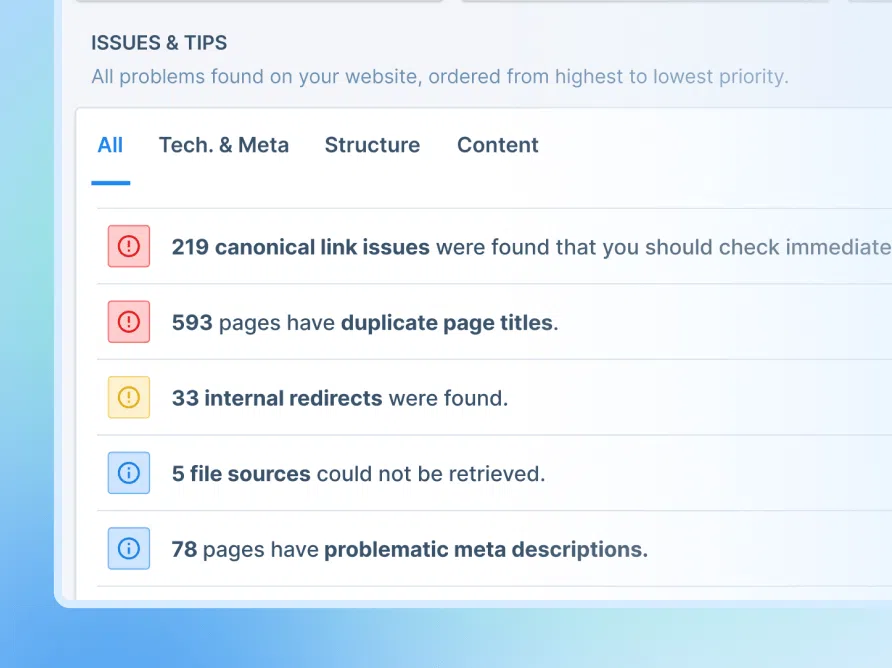
Seobility’s Website Audit crawls the site for technical and on-page problems, explains its findings, and prioritizes issues. Seobility says the audit checks more than 300 factors per page and provides more than 50 SEO reports.1 Those vendor-reported counts describe product scope; they are not independent measures of audit quality.
For this project, the practical benefit is the connection between finding an issue and creating an understandable optimization plan. That is especially relevant when an SEO specialist needs to hand recommendations to a less experienced colleague or client. Seobility explicitly positions its reports and instructions for both beginners and professionals.
Ahrefs Site Audit also crawls an entire website, identifies technical and on-page issues, recommends fixes, visualizes results, and calculates an overall Health Score. Ahrefs says it checks more than 170 predefined issues and can execute JavaScript while crawling.2 This can support a more exploratory technical investigation, particularly when the crawl needs to be considered alongside Ahrefs’ keyword and competitor research data.
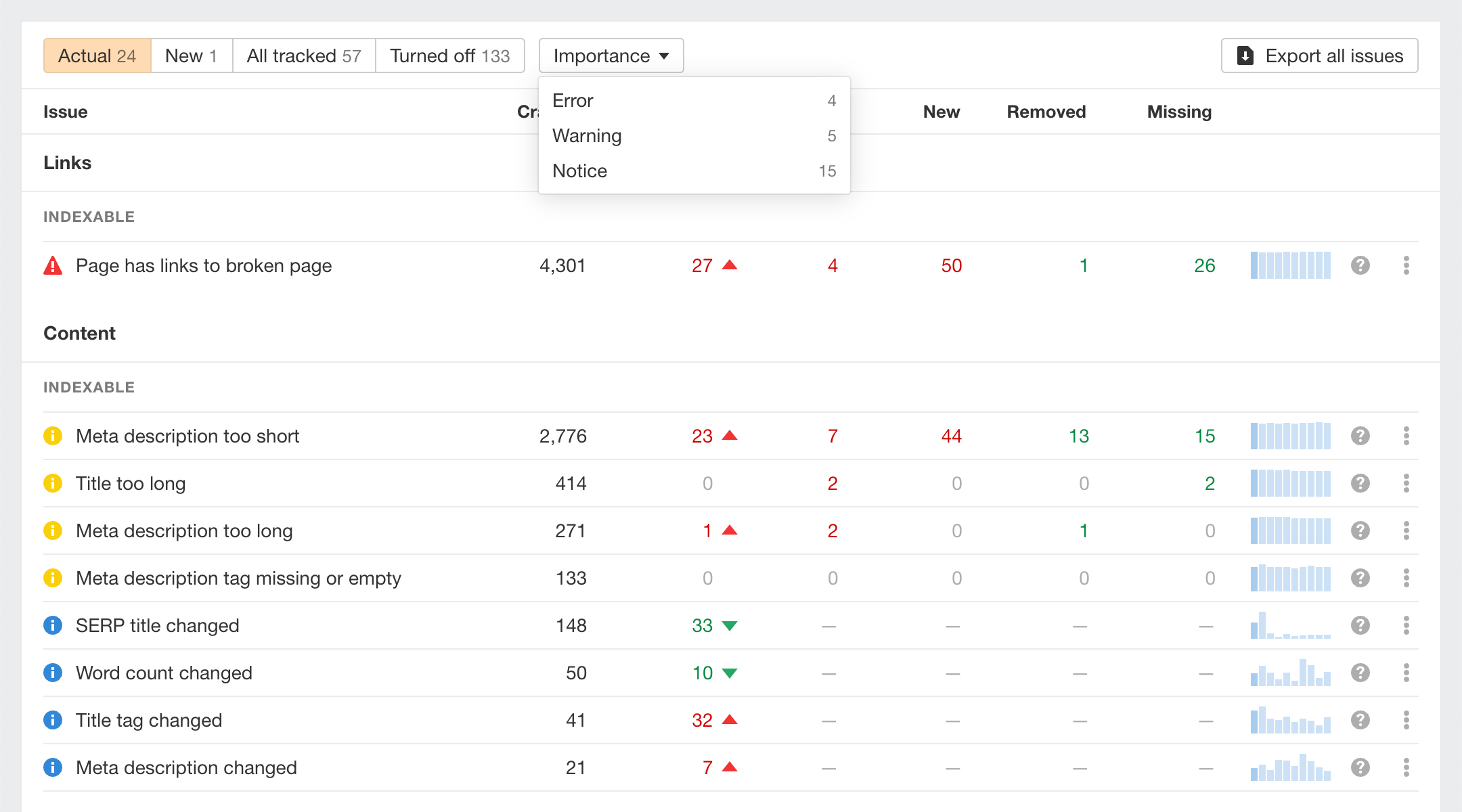
The figures “300 factors” and “170 issues” are not comparable units. The screenshots also contain unrelated vendor demonstration data, so their example issue counts should not be compared. The useful test is whether each audit covers your technical requirements and helps the people responsible for the site understand the next action.
2. Investigate where the opportunity sits
Suppose the audit reveals several technically healthy pages that still underperform. The next question is whether to improve their targeting, study competing pages, or pursue new topics and links.
Seobility keeps this work close to the properties you already manage. Its platform includes keyword and content tools, while Backlink Monitoring can compare competitor profiles, identify shared link sources, and suggest link-building opportunities. This supports a site-centered cycle: find a problem or opportunity, make a change, and continue monitoring the affected website.
Ahrefs divides wider research among several dedicated tools:
- Keywords Explorer supports keyword discovery, volume and difficulty metrics, Traffic Potential, clustering, intent-related analysis, and examination of current SERPs.
- Site Explorer investigates a competitor’s backlinks, organic keywords, pages, and estimated search performance.
- Content Explorer helps find successful content, link prospects, unlinked mentions, and brand or PR opportunities using performance filters.
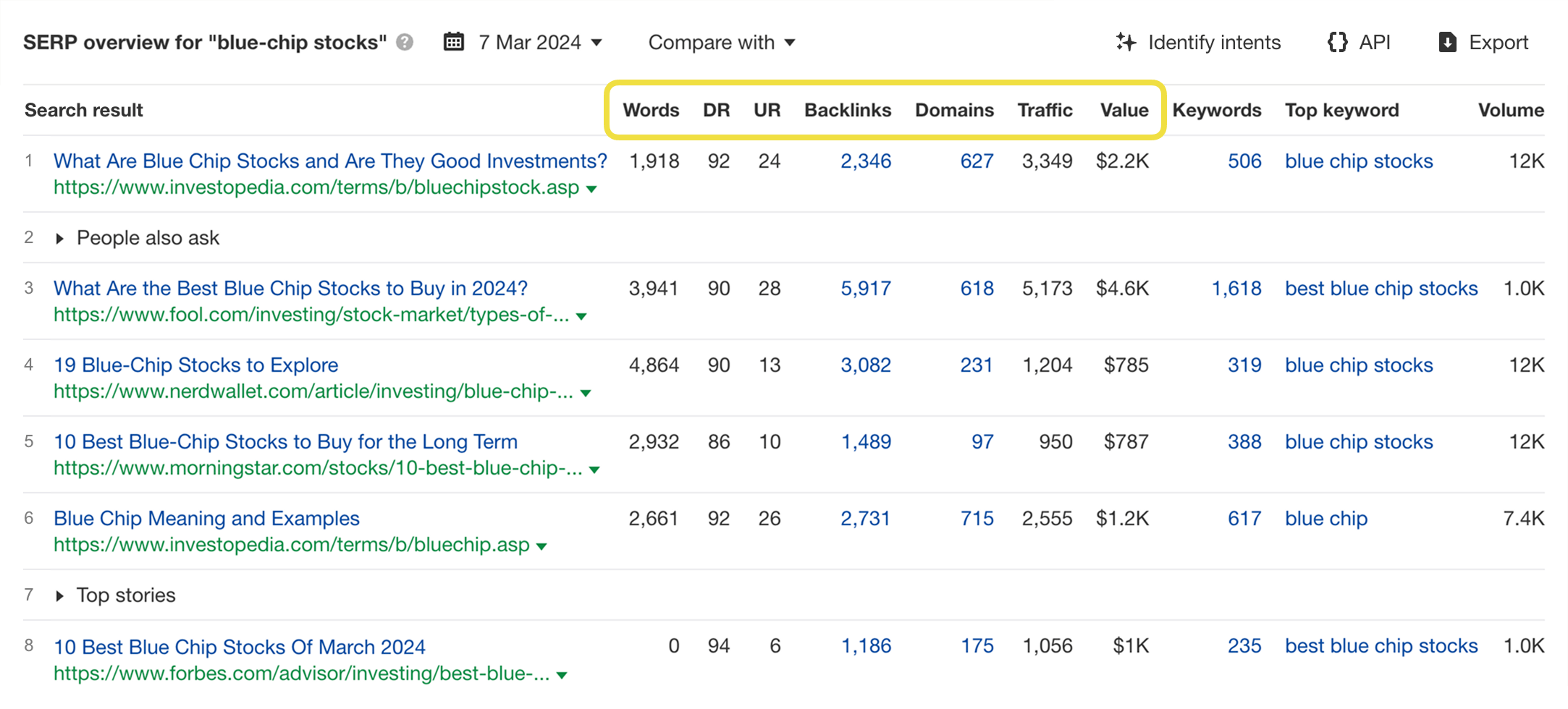
That separation becomes valuable when the investigation repeatedly moves beyond a known website—for example, when an agency is assessing a new market, mapping several competitors, or developing a digital PR campaign.
The available evidence does not show that either company has more accurate keyword or backlink data. No comparable independent dataset was used for this review. The defensible difference is the way the documented tools organize the research.
3. Monitor what changes next
After making improvements, Seobility Ranking Monitoring can track Google positions, update desktop rankings daily, show mobile rankings and historical trends, and benchmark competitors.3 Backlink Monitoring records new, lost, and broken links and provides competitor context. Together with the audit, these signals support continued maintenance of a defined set of websites.
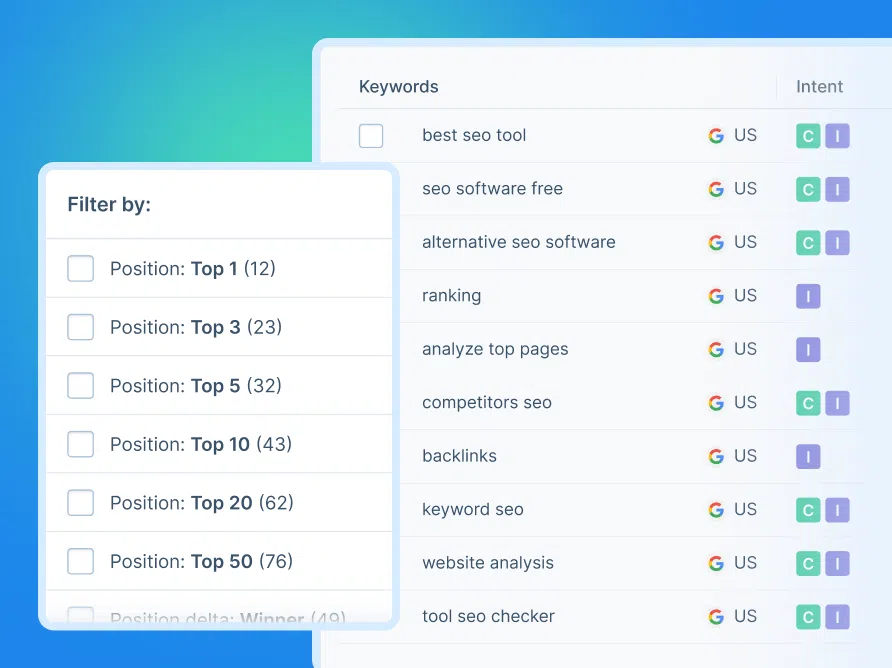
Ahrefs Rank Tracker supports desktop and mobile monitoring across more than 190 locations, including SERP-feature tracking, historical views, and competitor comparisons.4 Site Explorer adds backlink history, filters, and competitor-link investigation. This is useful when performance monitoring regularly leads back into broader market research.
Check the current allowances and update cadence for the exact locations, devices, projects, keywords, and competitors you need. Those limits can affect the decision more than a long list of capabilities.
What do users say about Seobility and Ahrefs?
Product pages tell you what a tool is designed to do. Reviews can help you understand what people notice when using it, but they are best treated as prompts for your own trial rather than a final verdict.
On 29 August 2026, G2 listed 402 Seobility reviews. Its platform-generated summary and categories highlighted straightforward use, an intuitive interface, and actionable optimization guidance, while also recording feature and limitation concerns.5 Those themes make the audit handoff worth testing: can the person responsible for a fix understand the issue, find the relevant report, and decide what to do next?
G2 listed 689 Ahrefs reviews on the same retrieval date. Its generated summary and categories emphasized keyword research and backlink analysis, while price and cost appeared among the recurring concerns.6 That suggests a different trial question: will your team use the research depth often enough for the selected plan and limits to make sense?
These are observations about G2’s aggregation, not a controlled head-to-head study. The samples differ in size, the summaries are generated by the review platform, and the reviews do not prove data accuracy, usability, or value for every team. We also sampled public Reddit discussions but excluded them from the comparison because the directly relevant comments were generally old, isolated, low-context, or affiliation-sensitive.
Which product fits your work?
Use a real project—not an abstract feature wishlist—to answer these questions:
| Question | If this describes your priority |
|---|---|
| Do you want an audit to produce a prioritized, understandable optimization plan? | Seobility deserves closer consideration. |
| Is most of your work focused on monitoring and improving a defined set of owned or client sites? | Seobility’s connected audit, ranking, backlink, reporting, and uptime structure is aligned with that job. |
| Is competitive backlink and organic-search research central to your role? | Ahrefs’ Site Explorer is built for that investigation. |
| Do you need dedicated keyword, SERP, content, and link-prospecting environments? | Ahrefs documents distinct tools for those workflows. |
| Do you track rankings across many markets, devices, and SERP features? | Compare Ahrefs’ broad location coverage with the allowances and cadence in the plan you are considering. |
| Do you need only a free check or a complete recurring workflow? | Separate Seobility Basic and Ahrefs Free or Starter access from the limits and tools included in their full paid plans. |
| Will several people use the platform? | Compare current user, project, crawl, keyword, and reporting limits rather than relying on the base price. |
This framework describes fit, not an objective winner. A small agency with technically sophisticated research needs may prefer Ahrefs, while an experienced SEO may still choose Seobility because most of their work revolves around maintaining client sites.
Final verdict
Seobility is the stronger candidate for a connected, guided process of auditing websites, prioritizing improvements, and monitoring results. Ahrefs is the stronger candidate when the job requires extensive research across competitors, keywords, backlinks, SERPs, and content.
If the choice is still unclear, run the same task in both products: audit one site, investigate one competitor, research one keyword, and review one ranking set. The better tool is the one that turns those questions into useful action within your team’s budget and working style.
Sources and methodology
Product capabilities and pricing were checked against official Seobility and Ahrefs pages on the retrieval dates shown. The screenshots are vendor-provided interface examples captured from official product pages; they demonstrate interface organization, not comparative data accuracy or performance. G2 summaries were used only as qualified third-party experience evidence, and weaker public-forum material was excluded. The recommendations are editorial interpretations of the cited evidence. No independent database comparison, controlled usability test, representative review study, or unsupported hands-on product testing is implied.
Footnotes
-
Seobility, Website Audit, retrieved 29 August 2026. The
300+ factorsand50+ reportsfigures are vendor-reported product-scope claims. ↩ -
Ahrefs, Site Audit, retrieved 29 August 2026. The
170+ issuesfigure and JavaScript-execution capability are vendor-reported. ↩ -
Seobility, Ranking Monitoring, retrieved 29 August 2026. Update frequency and available devices vary by plan. ↩
-
Ahrefs, Rank Tracker, retrieved 29 August 2026. Location coverage and tracking capabilities vary by plan; the official page currently lists weekly updates. ↩
-
G2, Seobility reviews, retrieved 29 August 2026. G2 displayed 402 reviews and labeled its summary as generated using AI from reviews; themes are platform aggregations, not independent usability findings. ↩
-
G2, Ahrefs reviews, retrieved 29 August 2026. G2 displayed 689 reviews and generated review-theme categories; themes are not independent performance or value findings. ↩